
When children run away to the circus, it is Seamus Harden who talks them down and gets them the help they need.
Spoilt teenagers, abused kids, Seamus sees it all.
Until one night Seamus meets a little a little girl with a perfect pink dress, perfect white socks, and a reason for running away to the circus that even Seamus has never heard before.
Scroll down for the most endearing circus story you’ll ever read.
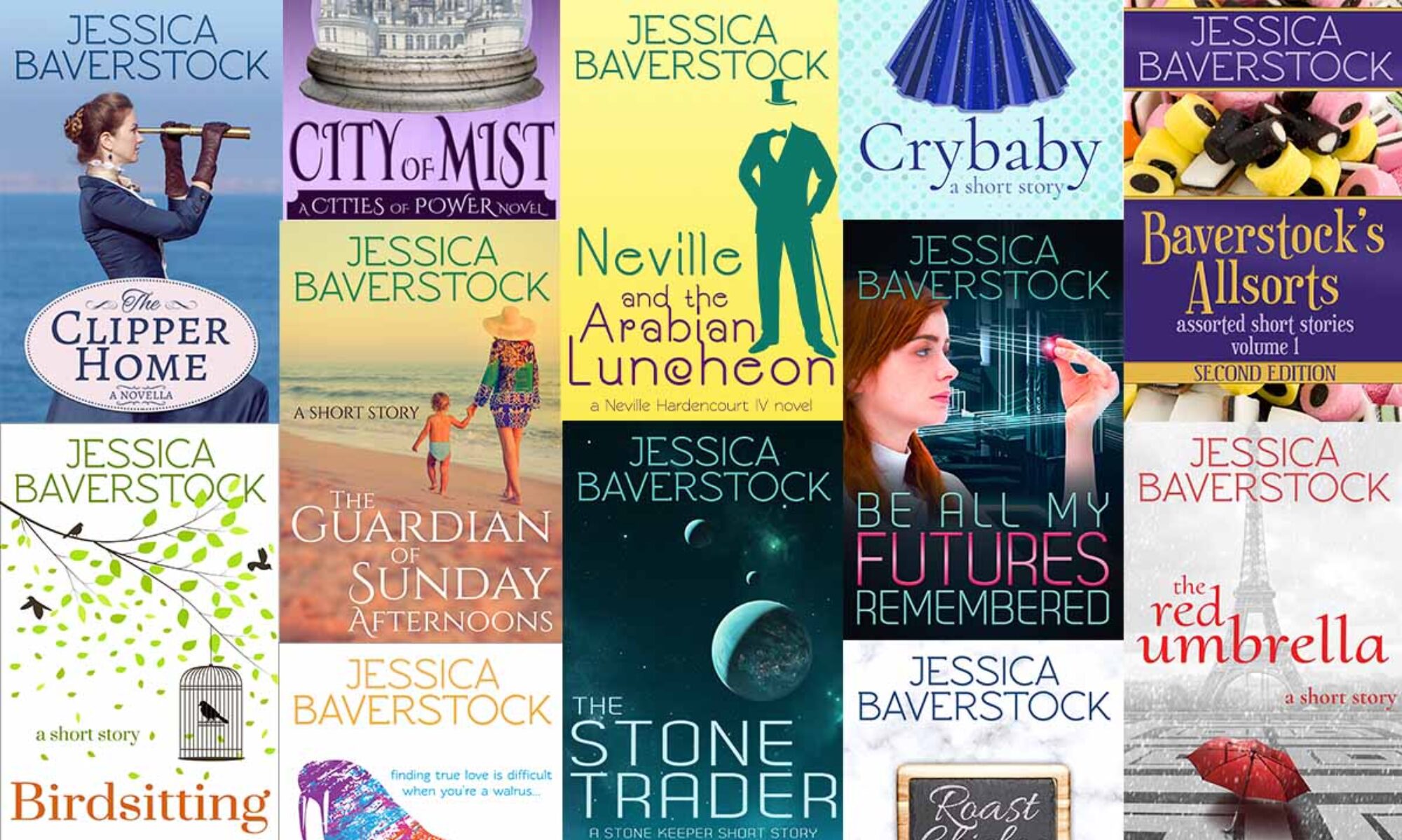
“The Runaway” is available for the month of April 2026 on this site. The ebook is also available on most major online retail stores. You can also read this story in the collection Baverstock’s Allsorts Volume 2.
The Runaway
By Jessica Baverstock
SEAMUS HARDEN EYED the Johnny Walker bottle in his hand with contempt. Reflected in its glass was the sweat-streaked clown paint that he’d been too tired to remove after the evening show.
The hot dusty wind off the Australian outback that had whipped around the outskirts of the small town covered him with a fine film of red dust, which he ignored.
He scratched at the straggly orange curls atop his head. If only they’d been a wig, like those most other clowns he worked with wore. He’d be able to rip them off at the end of the day and call it quits. Be a normal person.
But he’d been born a clown—bright red curls, doleful eyes, and a face that could contort into any expression—an ecstatic depressive for as long as he could remember. He could laugh in the face of adversity, grin in the darkest of despairs, and yet mistrustfully examine every silver lining until he found its grim and threatening cloud.
He blamed his Irish mother for this emotional roller coaster she had set him on as a babe in arms. But then everyone had some bone to pick with their mothers, didn’t they?
He dropped the bottle at his feet, its thud muffled by the layer of hay that had worked its way out of Gertie the Elephant’s enclosure, and sat back against the thick bars of her cage. The hubbub of a temporarily contented crowd returning home had subsided and the distorted, ominously happy music from the children’s carousel ride had finally been switched off. He could hear the tired chatter of some of his fellow performers passing nearby, finishing up their chores before pulling out a pack of cards for a little relaxation, but he had no desire to join them. After twelve hours of entertaining every living being who passed his way, he was grateful for the quiet afforded him in this little out-of-the-way corner.
A soft, warm shot of air blew past his ear as Gertie reached her trunk between the bars and nuzzled his hair, imbuing him with her grassy pong. Although he would never admit it, he enjoyed the feel of her touch, even if she was only interested in one thing. In an affection-starved life such as his, he would take a nuzzle however it came. He reached into the pocket of his white and orange clown suit and produced a badly bruised apple which Gertie quickly snatched from his fingers.
He closed his eyes and listened to the snort of enjoyment she gave as she popped the treat into her mouth. “No offence,” he said, his voice croaky from a day of miming his intentions rather than speaking, “but one of these days I’m going to have to call our relationship off and find myself a girl my own size.”
“Why?” said a little voice.
For a moment Seamus wondered if the voice had originated inside his head. It wouldn’t be the first time his mind had pranked him after a full day and a full bottle. Charleen the contortionist said she had so many voices in her head that they’d met up and formed a punk rock band in her frontal lobe. Legless Larry told her it was called a “migraine” and she should get help, but he’d been speaking through a milkshake straw at the time so she’d ignored him. And no one was brave enough to suggest the much more likely explanation that she was skitzo.
Seamus figured that having a voice in his head might not be a bad thing, especially a little voice that could easily be befriended. Perhaps he could talk to it instead of the elephant. It would do wonders for his body odour, as management was starting to mention his distinctive aroma de pachyderm. At least it masked the aroma de Johnny Walker.
A small pointed object jabbed him in the ribs as the voice repeated, “Why?”
He opened his eyes with a start and turned to see the origin of the voice.
She had sat down next to him, a doll-like figure of about seven or eight. A pale white face with fine, almost fragile features. Young brown eyes stared out of the whiteness at him, underscored by the dark lines of stress and tiredness. Her chocolate brown hair fell over her shoulders in ringlets, brushing the top of her frilly pink dress as she clasped her tiny hands in her lap. Her small feet were covered with fine white socks topped with lace elastic and shod in white, mud-spattered little shoes.
Seamus blinked at her, wondering if he was hallucinating. He had just made up his mind that he must have been, seeing as this tiny little girl seemed untouched by the red dust that pervaded everything around him, when she reached out a finger and jabbed him again.
“Hey,” he said, waving her little hand away, convinced now she was real, or at least that sharp little prodding finger was real.
“You didn’t answer my question,” she said with a pout, folding her white arms across her pink dress.
He blinked at her again. “What question?”
“Why?” she said with an innocent intensity.
“Why what?” Seamus glanced around, looking hopefully for parents or an older sibling in search of this little girl.
“Why do you have to find a girl your own size?”
Seamus massaged his sweat-speckled forehead, feeling the face paint smudging beneath his fingers as he tried to make sense of what was happening to him.
“Let’s start at the beginning, shall we?” he said after a moment’s thought. He wiped the paint from his hand onto his clown suit and then extended it gently towards her. “My name is Seamus the clown. And you are?”
“Alice Leely,” she said, extending her own tiny hand.
He took it and shook it once, carefully, amazed at how cold her little hand felt in his. “Nice to meet you, Alice Leely. Are you lost?”
“Oh no,” she said in a matter-of-fact manner, returning her hand to her lap where it lay obediently on her other hand. “I’m here to stay.”
“Excuse me?” He glanced again in search of some family member or guardian, but there were none. Only Gertie looked inquisitively from her cage, her trunk twitching this way and that as if she wished to reach out and mother the child.
“I’m joining the circus,” said the girl.
Seamus frowned and for a moment wondered if she was actually a trained performer, perhaps not a child but actually a woman, stunted in her growth. An eternal child.
He couldn’t stop himself from laughing. Was this perhaps some strange prank that was being played on him by his fellow performers? Had they heard his comment to Gertie about finding a woman his own size and sent her to play a role?
“What’s funny?” she said in a perfect childish voice. Her round brown eyes searched his, nervously.
If she was a performer, she was of excellent calibre. Too excellent for a travelling circus full of wannabes and has-beens pottering around in the outback. She should be in Sydney.
“Where are you from?” he said, his hand blindly fishing around for the discarded bottle in the hope there were still a few drops left.
“Here,” she said. “Steven’s Creek.”
Seamus’s hand gave up its search. The name of the town was familiar to him, although he had very little idea of where he actually was. Towns passed so quickly that he had stopped caring.
Her face took on a frustrated look and reluctantly she leaned forward to whisper. “I’ve run away from home.” Guilt flashed on her face and she sat back quickly, bunching her hands into little fists. A tear flickered at the corner of her eye but her face quickly turned into the expression of firm determination that only a true child can perform.
Seamus was lost for words. He had spoken to many runaway children in his time, but none had come anywhere close to this little girl.
There was the rebellious teenager type who had decided Mum and Dad were stifling their style and they wanted a taste of freedom. Or at least that’s what they said they wanted. What they actually wanted was to cause panic and stick it to their parents. They wanted control, not of their own life, but of their parents’ reactions. Usually a brief tally of the expenses of adult life, along with the perks of living without room and board, was enough to convince these runaways that they’d made their point and they should return home to bludge off the parents for a couple more years yet.
Then there was the abused kid type, the ones who were genuinely running away from a dire situation. Seamus always recognised them. He’d been one himself once. He’d give them the talk about how once you started running, you’d never stop running your whole life. And that it was a far better thing to stand up for yourself, get help, speak to someone who cared enough about you to want to help—because once you started running, it would be a long time before you could ever find another person like that.
Some of those kids went back, stronger, with purpose. Some couldn’t bear it. Seamus would never turn away a kid who couldn’t face home, but the life of the circus wasn’t the place to heal. Sometimes he’d talk with them all through the night and then the next morning contact a helpline or social worker who could take things further.
But this little girl, she was different.
“Why?” he said, realising the conversation had finally flipped in his favour. “Why have you run away from home?” He waggled his clown eyebrows at her in the hope it would loosen her up.
“Because I want to join the circus,” she said, sitting tall and stiff and sounding now like a broken record.
Seamus wondered whether it was her prepared response or whether she genuinely didn’t know how to talk about the problem. “Okay,” he said, relaxing his tone and his shoulders in the hope she would follow suit. “What do you want to be in the circus? Do you want to ride horses? Try the trapeze? Or maybe you want to have one of those pretty sparkly outfits that the contortionists wear?”
“I want to be a tax accountant,” she said, nodding her head firmly.
Seamus stared at her. “A tax accountant?”
“Yes.” She nodded again, determination in her eyes.
“I think maybe you are in the wrong place to be a tax accountant. You want the Travelling Attorney Show. They’re here next week.”
She furrowed her brow, his attempted humour clearly lost on her. “The circus makes money, doesn’t it?” she said.
Seamus nodded.
“Well then someone must do the accounts.”
Her logic was unassailable, and yet Seamus wondered how such a small child could have the vocabulary to talk about this subject. “I guess someone does.”
“Then I want to be a tax accountant.”
“Why?” He kept coming back to that question and yet she seemed just as reluctant to answer it. “Is someone you know in trouble with money?”
Pain and fear flickered across her face and Seamus knew he had hit upon the answer. He wished he could reach out and put his arm around her, try to offer some kind of comfort for whatever it was that had scared her into coming here. But he knew better than to touch her. The last thing he needed was for one of her parents to appear only to find him touching their daughter. Dreadful misunderstandings started in the most innocent of ways.
As if completely understanding his dilemma, Gertie reached her trunk between the bars of her cage and tapped the girl gently on the shoulder.
The little girl jumped in surprise, glancing at the elephant and then back to Seamus in fear.
“It’s okay,” he said. “She won’t hurt you. She just doesn’t want to see you cry.”
“I’m not crying,” the little girl said with surprising vehemence, even though her bottom lip was beginning to quiver.
“No, no. Of course not,” he said quickly. “You’re a very brave girl. Gertie just wants to give you a little hug.”
She turned her little white face toward the elephant and reached out a hand to touch Gertie’s trunk. Gertie moved her trunk closer and the little girl rested her face against it, closing her eyes, a solitary tear sliding down her cheek.
Seamus let her stay there, watching her quietly, wondering what he could possibly say to her. The key with all runaway children was to get them talking. Most just wanted a listening ear, someone who would hear what they had to say without judging or defending or attacking. Someone they could tell their deepest secrets and fears to without worrying about reprisals. And in the end they themselves often knew the answer. They could talk themselves into going home if Seamus just gave them enough time.
The little girl gave a big sigh and finally opened her eyes, wiping at them as she moved away from Gertie. “I’m not crying,” she said again.
Seamus gave her an understanding nod.
She brushed a few stray ringlets away from her face and then looked up at him, expectantly.
“So…” said Seamus, leaving the pregnant pause there for her to fill.
“So.” She seemed to enjoy the silence, sitting so still Seamus began to worry something was wrong.
“What is it you think a tax accountant does exactly?” he said, watching to make sure she was still breathing.
Her eyes widened in surprise, as if he should already know. “Why, magic, of course.”
“Ah,” said Seamus, trying to nod knowingly. “Magic. What kind of magic?”
She began to look impatient. “Money magic.”
“They magically give you more money?” he said, wishing to clarify her description.
“No.” She rolled her eyes. “They get your money back for you. The government has your money and the tax accountant gets the government to give you the money back.”
“Ah.” Seamus was now able to nod knowingly with sincerity since this was the clearest description of a tax accountant he had ever heard. “And you want to learn this magic?”
“Yes,” she said, turning to Gertie with a smile.
“When you have learnt to be a tax accountant,” he said gently, “who will you use your magic to help?”
Her beautiful, innocent eyes clouded over and she turned a sad face back to him. “My daddy.”
Seamus forced himself to take a long and slow breath, giving the words the room they deserved in the conversation and allowing her to add to them if she wished.
“He has cattle,” she said, looking down at her hands as they twisted her pink skirt between her fingers. “And there has been a drought. That’s when there isn’t enough rain.” She looked up at him as she added this explanation, checking that he understood.
He nodded. “Go on.”
“Well.” She looked back at her hands. “He says that this year the taxes will be the death of him.” Her voice broke as she said the last three words.
Seamus fought the urge to jump in with adult words—to tell her that her father didn’t mean it, that he was just using an expression, that taxes couldn’t really kill a person.
He held that all back, because it didn’t matter.
Those words wouldn’t work because they weren’t important. What mattered was that this little girl believed her daddy was in mortal danger and she had come here to save him.
Gertie reached out her trunk and the little girl let it curl around her, nestling into it as if it were her mother’s arms. The girl closed her eyes and breathed deeply.
“What does your mummy say?” said Seamus.
“Don’t got a mummy,” said the little girl, finally speaking in little girl sentences. “Just a great aunt. Who isn’t that great,” she added in a naughty whisper.
Seamus muffled his guffaw. In his experience, great aunts rarely lived up to their title.
He stared at the little girl, so fragile, wrapped up in Gertie’s trunk, and wondered how he could possibly fix the situation.
She was too young for adult reasoning and yet also too old to fall for being told everything would be all right. Clearly life hadn’t been all right so far, so why would it start now?
“Alice,” he said, thinking how perfectly her name fitted her.
She opened her eyes and looked at him. “Yes?”
“Alice, I have something to tell you.”
She lifted her head as he spoke, her big eyes looking so tired now.
“You can’t be a tax accountant,” he said with the tone of one adult speaking plainly to another. “It will take you too long to learn and your daddy needs help now.”
Tears welled up in her eyes as her despair threatened to overflow.
“But,” he said, “there is something else you can do that might just fix the problem. It requires a lot of courage. Are you willing to give it a go?”
“Yes,” she said, sitting up straight again and wiping her eyes with the backs of her hands. “Anything.”
“Taxes can never be the death of your daddy so long as you are there with him every morning and every night.”
Her eyes watched him, wide and hopeful.
“Your kiss is a protection,” he said. “One kiss in the morning at breakfast and one before bed will protect him. Do you understand?”
She nodded so vigorously that she shook all over. “And that will work?”
“Yes,” he said. “I promise.” And he meant it and believed it with all his heart.
A wide, relieved smile finally broke across her face and she wrapped her arms tightly around Gertie’s trunk with a squeal of happiness.
Gertie snorted back in surprise.
“Gently,” Seamus reminded her.
“Oh no,” she said, letting go of Gertie and turning to him with worry. “But I haven’t kissed daddy before bedtime tonight.”
“Then we shall have to get you back to your home before bedtime,” said Seamus, standing up.
And at that moment he caught the tail end of a father’s holler in the distance. “Alice!”
“Daddy?” replied the little girl, and before Seamus could reach out to take her hand she had jumped to her feet and set off running.
Seamus followed as quickly as his over-sized clown shoes would allow him.
By the time he reached the end of the caravans, Alice had bounded into the open and was being scooped up into her father’s arms.
Her father clutched her to himself and buried his face in her ringlets.
Seamus watched for a moment, feeling stabs of bitterness and pain within the elation. He wondered if somewhere in the world there was a little auburn-haired Irish mother searching for her son. Would she clutch him to her chest if he returned?
With a shake of his head he turned round and slowly walked back to Gertie’s cage. He bent down to pick up the empty whiskey bottle and then turned to look the elephant in the eye.
“We make a good team, you and I,” he said, reaching through the bars to pat her. “Maybe you’re the girl for me after all.”
Then he sat himself down, facing Gertie, and began to talk.
Maybe, eventually, he would talk himself into going home.
“The Runaway” is available for the month of April 2026 on this site. The ebook is also available on most major online retail stores. You can also read this story in the collection Baverstock’s Allsorts Volume 2.
“The Runaway”
Copyright © Jessica Baverstock
Cover and Layout copyright © Jessica Baverstock
Cover design by Jessica Baverstock
Cover art © Jagodka/Shutterstock, gdakaska/Pixabay, and GDJ/Pixabay
This book is licensed for your personal enjoyment only. All rights reserved. This is a work of fiction. All characters and events portrayed in this book are fictional, and any resemblance to real people or incidents is purely coincidental. This book, or parts thereof, may not be reproduced in any form without permission.
Training of generative artificial intelligence (“AI”) using this publication is expressly prohibited. The author and publisher reserve all rights to license uses of this work for generative AI training and development of machine learning language models.